| id | samples-echo | ||||||
|---|---|---|---|---|---|---|---|
| title | Echo SQL Sample Application | ||||||
| sidebar_label | Echo + Postgres | ||||||
| description | The following sample app showcases how to use Echo framework and the Keploy Platform. | ||||||
| tags |
|
||||||
| keywords |
|
import InstallReminder from '@site/src/components/InstallReminder'; import SectionDivider from '@site/src/components/SectionDivider';
import ProductTier from '@site/src/components/ProductTier';
A Sample url shortener app to test Keploy integration capabilities using Echo and PostgreSQL
git clone https://github.com/keploy/samples-go.git && cd samples-go/echo-sql
go mod downloadWe will be using Docker compose to run the application as well as Postgres
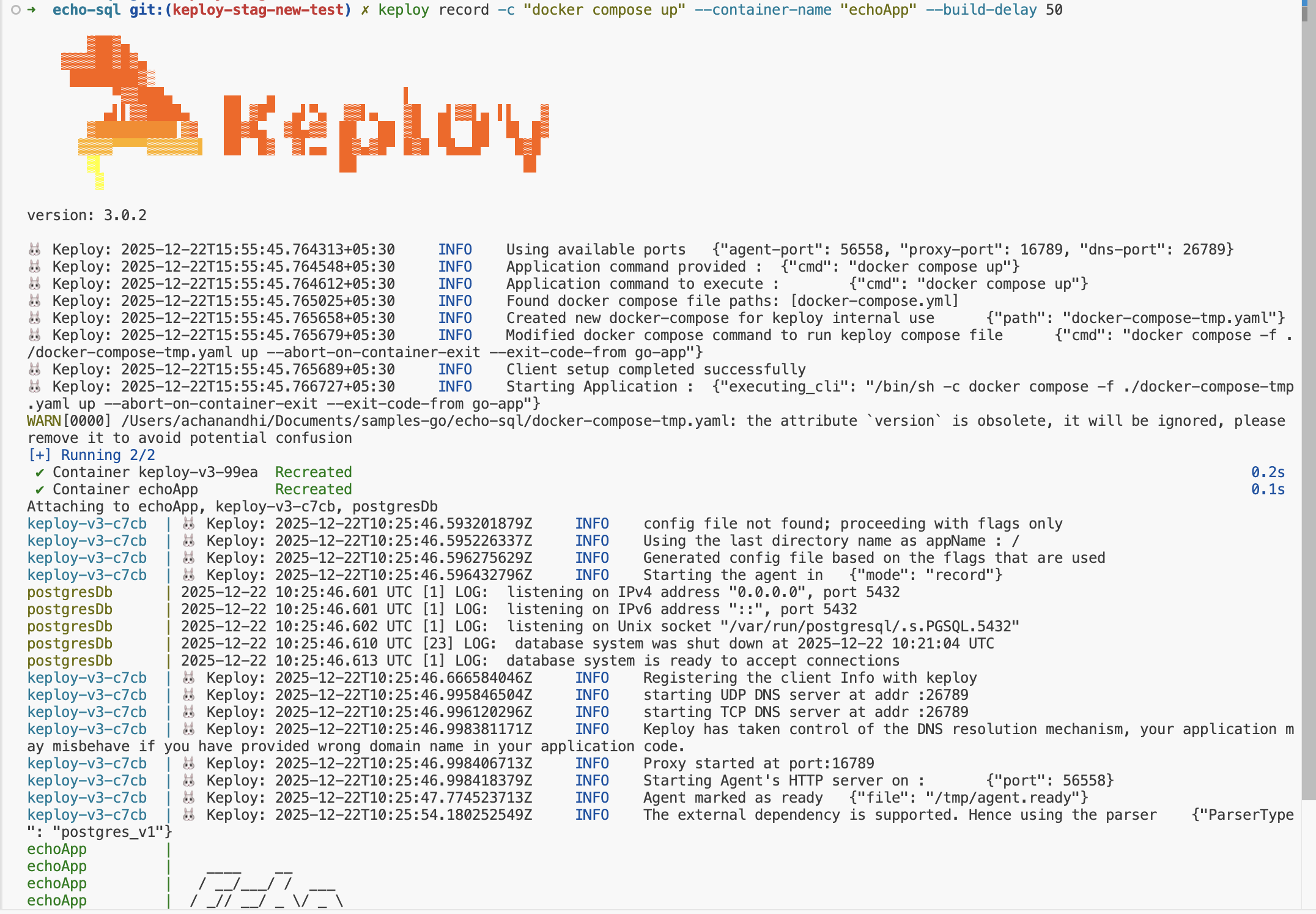
keploy record -c "docker compose up" --container-name "echoApp" --build-delay 50
--build-delayadds a buffer (in seconds) to allow images to build/pull and services to start before Keploy begins interception. If your services are already up, you can omit it.
Make API Calls using cURL command. Keploy with capture those calls to generate the test-suites containing testcases and data mocks.
To generate testcases we just need to make some API calls. You can use Postman or simply curl
curl --request POST \
  --url http://localhost:8082/url \
  --header 'content-type: application/json' \
  --data '{
  "url": "https://github.com"
}'
this will return the shortened url. The ts would automatically be ignored during testing because it'll always be different.
{
  "ts": 1647802058801841100,
  "url": "http://localhost:8082/GuwHCgoQ"
}curl http://localhost:8082/GuwHCgoQ- Or by querying through the browser
http://localhost:8082/GuwHCgoQ
Now both these API calls were captured as editable testcases and written to keploy/tests folder. The keploy directory would also have mocks file that contains all the outputs of postgres operations. Here's what the folder structure look like:
<img src="https://keploy-devrel.s3.us-west-2.amazonaws.com/keploy_record_sql_command.png" alt="Sample Keploy Record" width="100%" style={{ borderRadius: '5px' }} />
Now, let's see the magic! ✨💫
Want to see if everything works as expected?
Time to put things to the test 🧪
keploy test -c "docker compose up" --container-name "echoApp" --build-delay 50 --delay 10output should look like
<img src="https://keploy-devrel.s3.us-west-2.amazonaws.com/keploy_replay_sql_command.png" alt="Sample Keploy Test " width="100%" style={{ borderRadius: '5px' }} />
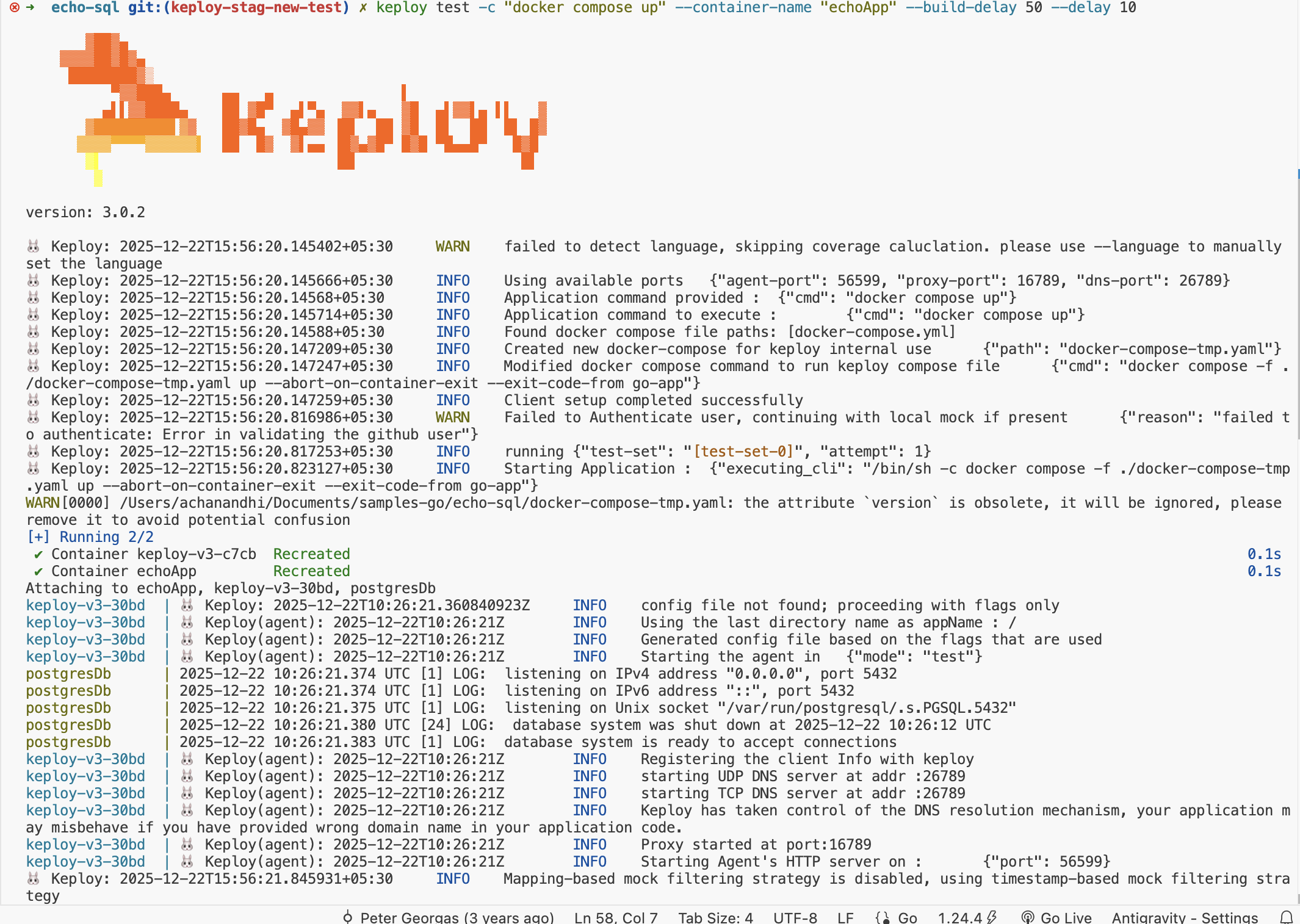
So no need to setup fake database/apis like Postgres or write mocks for them. Keploy automatically mocks them and, The application thinks it's talking to Postgres 😄
Congrats on the journey so far! You've seen Keploy's power, flexed your coding muscles, and had a bit of fun too! Now, go out there and keep exploring, innovating, and creating! Remember, with the right tools and a sprinkle of fun, anything's possible.😊🚀
Happy coding! ✨👩💻👨💻✨
A Sample url shortener app to test Keploy integration capabilities using Echo and PostgreSQL
git clone https://github.com/keploy/samples-go.git && cd samples-go/echo-sql
go mod download
We'll be running our sample application right on Linux, but just to make things a tad more thrilling, we'll have the database (Postgres) chill on Docker. Ready? Let's get the party started!🎉 Using the docker-compose file we will start our Postgres instance:-
docker-compose up postgresSince we are using docker to run the application, we need to update the
postgreshost on line 41 inmain.go, update the host tolocalhost.
Now, we will create the binary of our application:-
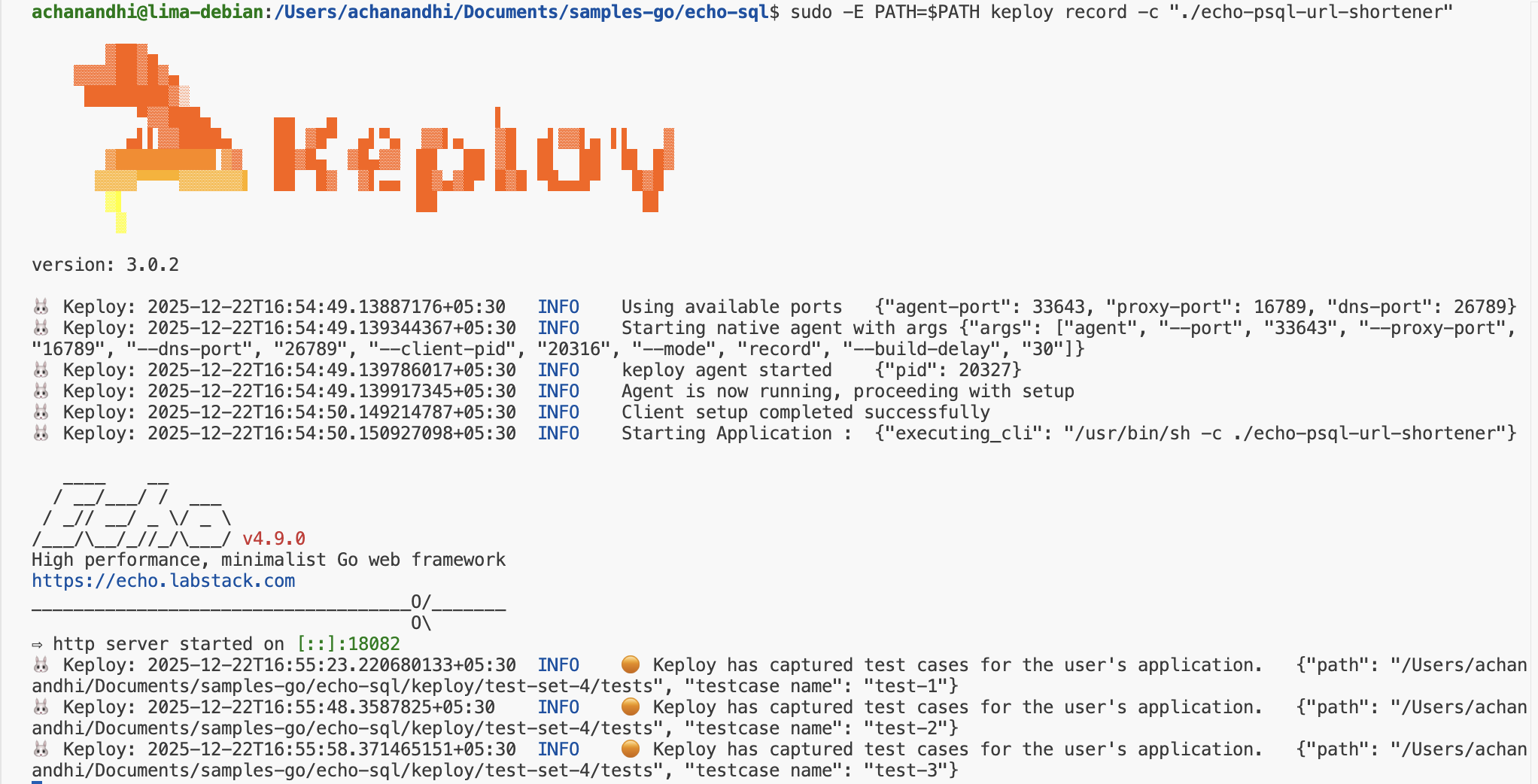
go build -o echo-psql-url-shortenersudo -E PATH=$PATH keploy record -c "./echo-psql-url-shortener"<img src="https://keploy-devrel.s3.us-west-2.amazonaws.com/keploy-record-echo-sql-binary.png" alt="Sample Keploy Record" width="100%" style={{ borderRadius: '5px' }} />
To genereate testcases we just need to make some API calls. You can use Postman, Hoppscotch, or simply curl
curl --request POST \
  --url http://localhost:8082/url \
  --header 'content-type: application/json' \
  --data '{
  "url": "https://google.com"
}'
this will return the shortened url.
{
  "ts": 1645540022,
  "url": "http://localhost:8082/Lhr4BWAi"
}curl http://localhost:8082/Lhr4BWAior by querying through the browser http://localhost:8082/Lhr4BWAi
Now, let's see the magic! 🪄💫
Now both these API calls were captured as a testcase and should be visible on the Keploy CLI. You should be seeing an app named keploy folder with the test cases we just captured and data mocks created
Now that we have our testcase captured, run the test file.
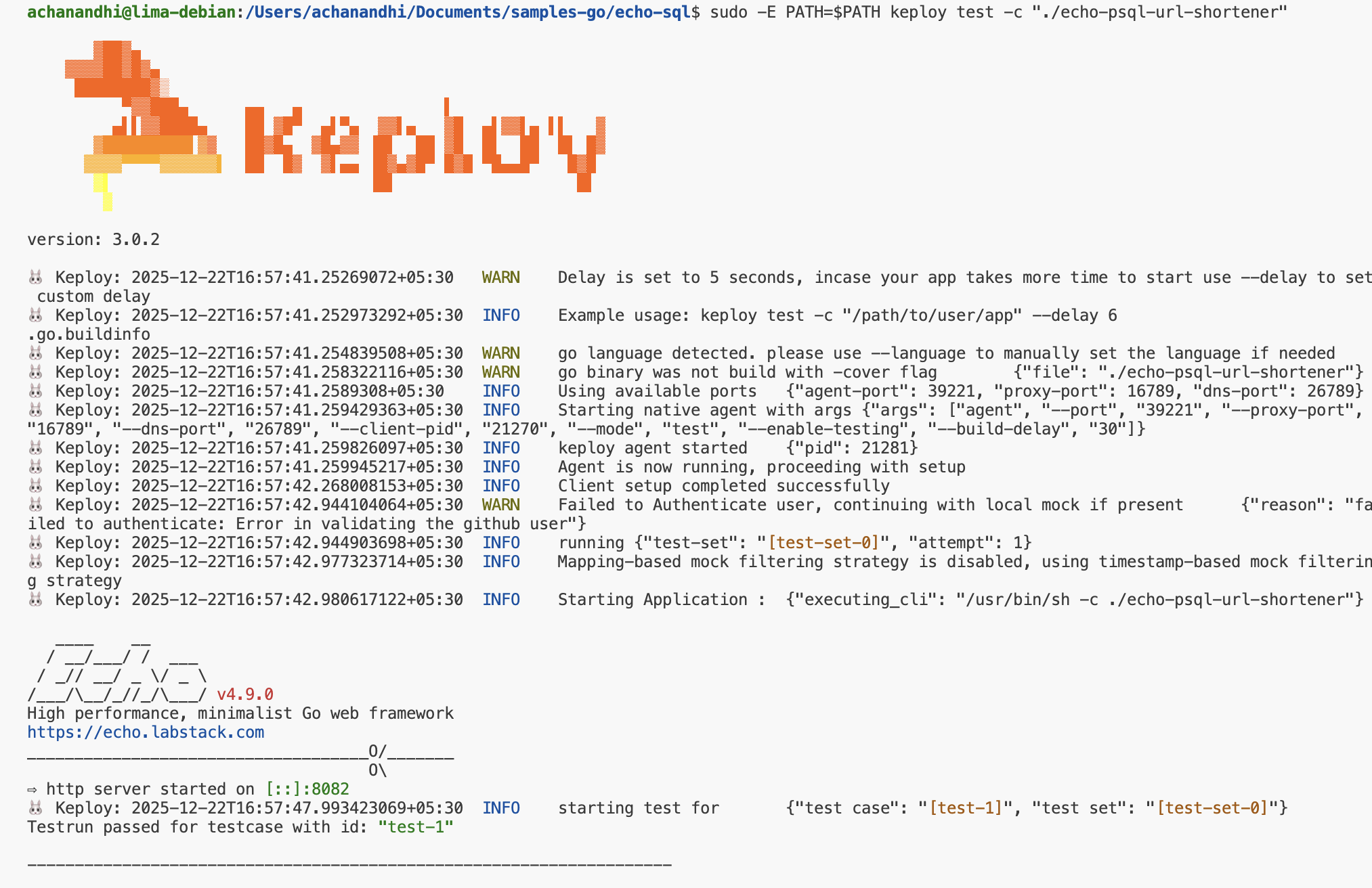
sudo -E PATH=$PATH keploy test -c "./echo-psql-url-shortener"So no need to setup dependencies like postgres, web-go locally or write mocks for your testing.
The application thinks it's talking to postgres 😄
We will get output something like this:
<img src="https://keploy-devrel.s3.us-west-2.amazonaws.com/keploy-replay-echo-sql-binary.png" alt="Sample Keploy Record" width="100%" style={{ borderRadius: '5px' }} />
Congrats on the journey so far! You've seen Keploy's power, flexed your coding muscles, and had a bit of fun too! Now, go out there and keep exploring, innovating, and creating! Remember, with the right tools and a sprinkle of fun, anything's possible.😊🚀
Hope this helps you out, if you still have any questions, reach out to us .