Back off NYM mixFetch setup after a failure - #738
Conversation


74d1da5 to
1899d9b
Compare

Bugbot is paused — on-demand spend limit reachedBugbot uses usage-based billing for this team and has hit its on-demand spend limit. A team admin can raise the spend limit in the Cursor dashboard, or wait for the next billing cycle to continue. |

|
You have reached your Codex usage limits for code reviews. You can see your limits in the Codex usage dashboard. |

 peachbits
left a comment
peachbits
left a comment
peachbits
left a comment
There was a problem hiding this comment.
The cooldown is the right shape and the doubling matches the changelog. Four notes: one comment that misdescribes the library, one hazard the new timeout opens up in the pre-existing cleanup block, and one set of resets in the success path that turn out to be unreachable (which is also why the third test passes either way).

|
All four taken, no rejections. The comment at the top of the setup now describes what the library actually does, the failure handler arms the cooldown before firing an unawaited disconnect, and the unreachable success-path resets are gone with the test case that appeared to cover them. The hang you flagged is now covered: a new case makes the fake |
peachbits
left a comment
peachbits
left a comment
There was a problem hiding this comment.
Correction to my earlier review. I diffed against a stale local master (2.46.1), which folded 2.47.x/2.48.0 into what I read as this PR's diff. Three notes therefore described pre-existing code as new — one of them on a factually wrong premise. Retracting that one and re-scoping the rest below. The notes on the .then resets (114-116), the third test case, and the *ForTests export were about code this PR actually adds and stand as written.
|
Re-scoping noted, and the three re-scoped notes are answered in their threads. Two produced code: the catch block now arms the cooldown before firing an un-awaited |
📸🪓 Test evidence: cooldown driven in the running app
🪓 HACK-FORCED: nym mixnet enabled
🪓 HACK-FORCED: nym cooldown ab
Captured by the agent's in-app test run (build-and-test). |

d71fac6 to
eec286f
Compare
2 participants


Technical Design Document
zano-migration-off-module-queue.md
CHANGELOG
Does this branch warrant an entry to the CHANGELOG?
Dependencies
none
Description
QA reported an iOS test account logging itself out every minute or so with auto-logout set to one hour. The attached logs show it is not the logout timer: each re-login is preceded by
EdgeContext closedand thenEdgeContext openedabout a second later, with no JS bundle relaunch. That isEdgeCoreWebView.webViewWebContentProcessDidTerminatecallingvisitPage(), so iOS killed the core WebView's WebContent process for memory and the core reloaded itself, dropping the session.What exhausts the memory is the NYM mixFetch setup path.
initMixFetchsets its cached promise back to null whenever a setup fails, so the next privacy fetch immediately builds another client.createMixFetchspawns a web worker that loads about 13 MB of WASM before it ever contacts the gateway, and the library exposes no way to terminate that worker, so each failed attempt leaves one behind. With an engine poll loop driving a request every few seconds against a gateway that is refusing the client, roughly thirty workers accumulate inside a minute and the WebContent process is killed.In the reported logs every crash-looping session carries
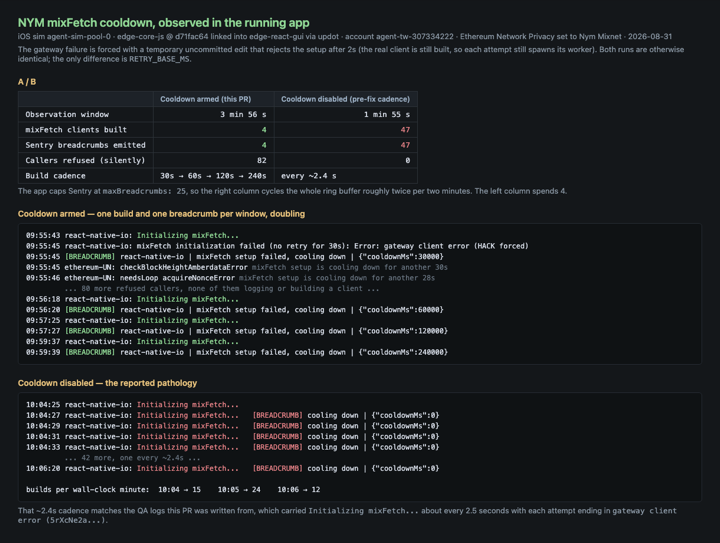
Initializing mixFetch...about every 2.5 seconds, each ending ingateway client error (5rXcNe2a...); the one long healthy session in the same file has no mixFetch lines at all.This change gives a failed setup a cooldown, starting at 30 seconds and doubling to a 5 minute ceiling. Callers arriving during the cooldown reject immediately instead of building another client, so a dead gateway costs one worker per window instead of one per request.
The reported symptom needs both an account with NYM privacy enabled and a failing gateway, which is why it does not appear on a default account.
What review changed
Four rounds with @peachbits reshaped the details, and the notes are worth carrying here because each one is load-bearing:
async: it nulls the cached promise, records the error and setsretryAfterfirst, then firesdisconnectMixFetch().catch(() => {})without awaiting it. Comlink's request path (index.js:342-351) builds a promise with no reject and no timeout, so a disconnect issued against a worker the OS already killed never settles. Awaiting it stranded every line below, the cooldown included, which is the freeze this PR exists to prevent. A test makes the fake disconnect hang forever and fails against the awaited form.lastErrorhanded callers a stack from a setup that ended minutes ago, so a 0 ms rejection read in a crash report as a fresh 60 second timeout. The rejection now names the remaining wait and carries the original ascause, which also drops the assumption thatlastErroris anErrorat all: the library rejects with a rawMessageEventon a worker error.maxBreadcrumbs: 25(src/app.ts:45), so a poll loop refusing every few seconds would evict the app's whole breadcrumb history inside a minute, blinding the crash report this fix exists to inform. The breadcrumb moved to the arming site and names the window actually armed. A test asserts the cardinality, since the failure mode is silent.makeMixFetchSetup(now = () => Date.now())closes over the cooldown state, andexport const initMixFetch = makeMixFetchSetup()keeps both io call sites unchanged. That removed aresetMixFetchForTestsexport and a mutable module clock from the shipped surface, and gives each test fresh state for free. Its one caveat is documented on the function: the cooldown state is per instance while the client, its worker andwindow.__mixFetchGlobalare process-global, so the single exported instance is the only supported arrangement.Testing
test/util/nym.test.tsdrives the module against a controlled clock and counts how many clients get built. Five cases: twenty-five seconds of requests after a failure build exactly one client; a cooling-down caller is rejected with the naming error and the preservedcause; the breadcrumb fires once per window across eleven refusals and again on the next window; a retry happens once the window expires and the wait doubles after the second failure; and the cooldown still arms when the cleanup disconnect never settles. Each case was checked against the pre-fix code it guards.The full suite reports 168 passing,
npm run typesis clean, andverify-repo.shpassed.Driven in the app on an iOS simulator, with
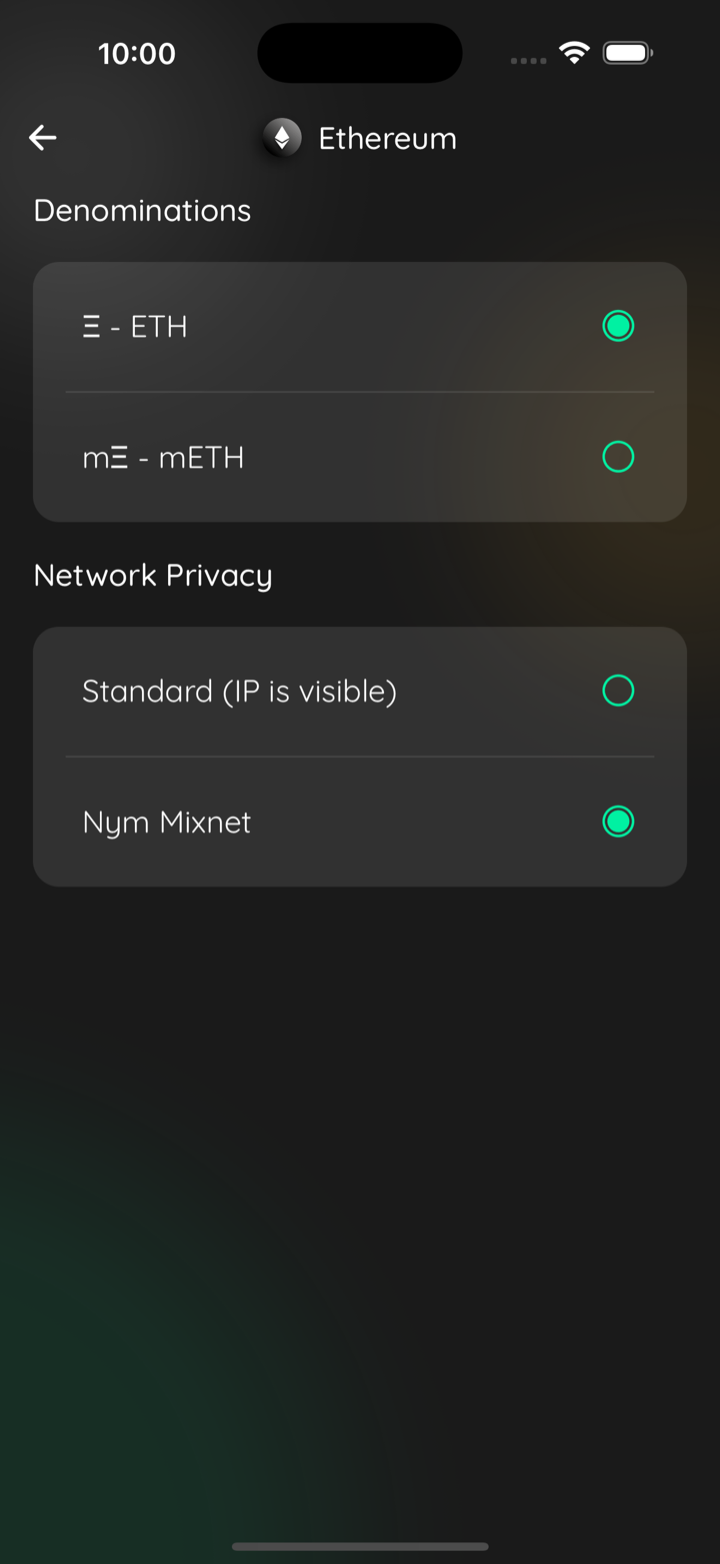
edge-core-jslinked intoedge-react-guivia updot and Ethereum's Network Privacy set to Nym Mixnet. The gateway failure is forced with a temporary uncommitted edit that rejects the setup after 2s, while still building the real client so each attempt still spawns its worker. Over 3m56s the engine's poll loop produced 82 privacy fetches, and the cooldown answered them with 4 client builds and 4 breadcrumbs, at 30s, 60s, 120s and 240s. The same drive withRETRY_BASE_MSset to 0 produced 47 builds and 47 breadcrumbs in 1m55s, one every ~2.4s, which is the cadence the QA logs carried. Screenshots are in the test-evidence comment below; both edits are reverted.Still not verified: that WebContent memory stays flat across a long outage on a real device. The build rate is what this change controls and it is now measured, but the resulting memory ceiling was not observed on hardware.
Asana: https://app.asana.com/0/1215088146871429/1217733586839287
Parent: https://app.asana.com/0/1215088146871429/1217559756673909
Note
Medium Risk
Changes NYM privacy fetch initialization on failure paths; mis-tuned backoff could delay recovery when the gateway returns, but the behavior only affects accounts with NYM privacy and a failing setup.
Overview
Fixes an iOS symptom where NYM privacy with a failing gateway looked like repeated logouts: each failed
createMixFetchleft a WASM web worker alive, andinitMixFetchcleared its cached promise on failure so poll-driven privacy fetches spawned a new worker every few seconds until the WebView process was killed for memory.makeMixFetchSetupnow owns per-instance cooldown state; production still usesexport const initMixFetch = makeMixFetchSetup(). After a failed setup (including the existing 60s timeout), new attempts are refused until a backoff window passes—30s initially, doubling up to 5 minutes—instead of callingcreateMixFetchagain. Callers during cooldown get a fresh “cooling down” error with the original failure oncause, not a re-thrown stale error. The cooldown is armed before best-effortdisconnectMixFetch/ global cleanup, which are not awaited so a hanging disconnect cannot block later callers. One Sentry breadcrumb is emitted per cooldown window.test/util/nym.test.tscovers client count, errors, breadcrumbs, backoff, and hang behavior with a fake mix-fetch module and injectable clock.Reviewed by Cursor Bugbot for commit eec286f. Bugbot is set up for automated code reviews on this repo. Configure here.