Secure deterministic procedural avatars for Rust.
Bounded identity hashing, asset-free rendering, WebP/SVG output, typed cache keys, and explicit resource controls.
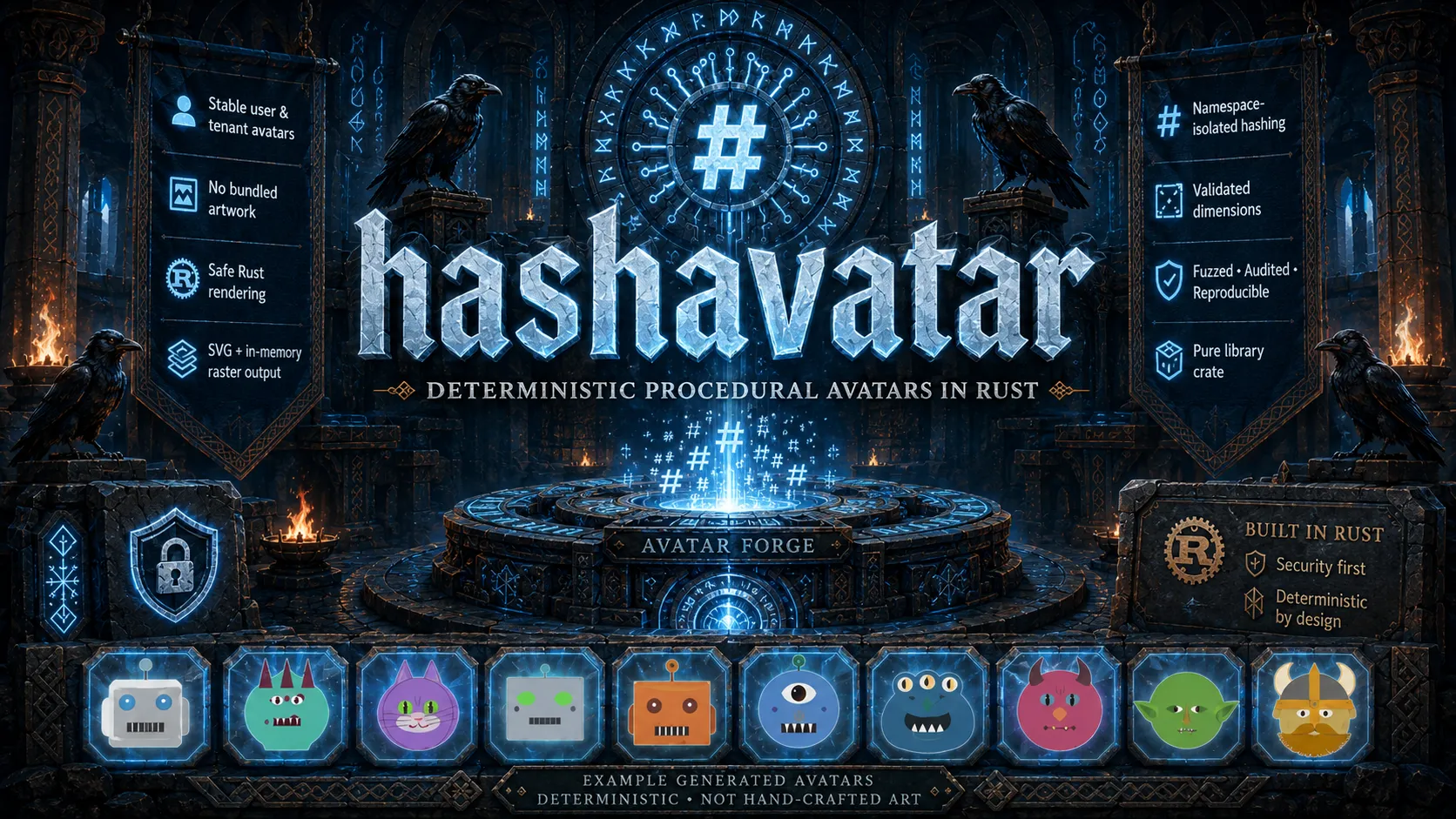
hashavatar generates deterministic avatars from bounded identity bytes. It
ships no character artwork, sprite sheets, templates, HTTP server, CLI, or
filesystem-writing API. Raster and SVG output are produced from Rust drawing
code and returned to the caller.
The normal path validates dimensions and identity lengths, derives a namespace-isolated identity, resolves a complete style, exposes conservative resource information, and binds output and cache keys to one prepared request.
The examples below describe the published 1.3.0 API. Development and support
state lives in Current Status.
| Need | Start with |
|---|---|
| New application workflow | AvatarIdentity + AvatarRequest::builder(...).prepare() |
| Existing concise integration | AvatarBuilder::for_id(...) |
| Automatic complete style | .automatic_style() |
| User-selected strict style | AvatarRequestBuilder or .strict_style_validation() |
| Caller-owned RGBA memory | PreparedAvatar::render_into() |
| SVG or encoded writer | write_svg() or encode_to_writer() |
| Stable cache routing | Typed identity, avatar, semantic, and build asset keys |
| Tenant isolation | AvatarNamespace |
| Public web endpoint | Crate validation plus application rate/concurrency limits |
New code should prefer a prepared request. AvatarBuilder remains supported
for established integrations and short examples.
Default SHA-512 identity derivation, WebP encoding, and SVG rendering:
[dependencies]
hashavatar = "1.3.0"
Enable additional raster encoders explicitly:
[dependencies]
hashavatar = { version = "1.3.0", features = ["png", "jpeg", "gif"] }
Enable BLAKE3 identity derivation:
[dependencies]
hashavatar = { version = "1.3.0", features = ["blake3"] }
blake3 and xxh3 are mutually exclusive crate-wide identity modes. Extra
raster encoders and serde support for public style enums are disabled by
default.
Prepare one immutable request and use it for metadata, keys, and output:
use hashavatar::prelude::*;

let namespace = AvatarNamespace::new("tenant-a", "avatars-v2")?;
let identity = AvatarIdentity::new_with_namespace(namespace, "user-123")?;
let prepared = AvatarRequest::builder(identity)
    .size(256, 256)
    .kind(AvatarKind::Robot)
    .background(AvatarBackground::Transparent)
    .accessory(AvatarAccessory::Glasses)
    .color(AvatarColor::Gold)
    .expression(AvatarExpression::Happy)
    .shape(AvatarShape::Circle)
    .prepare()?;

let key = prepared.avatar_asset_key();
let image = prepared.render()?;
let svg = prepared.render_svg();
let webp = prepared.encode(AvatarOutputFormat::WebP)?;

assert_eq!(image.dimensions(), (256, 256));
assert!(svg.starts_with("<svg "));
assert!(!webp.is_empty());
assert!(!key.to_hex().is_empty());

# Ok::<(), Box<dyn std::error::Error>>(())
Preparation validates the specification, resolves style compatibility, and freezes the identity/spec/style tuple used by layout reports, resource budgets, cache keys, rendering, SVG, and encoding.
Derive family, background, accessory, accent color, expression, and frame from distinct identity digest bytes:
use hashavatar::prelude::*;

let identity = AvatarIdentity::new("user@example.com")?;
let prepared = AvatarRequest::builder(identity)
    .size(256, 256)
    .automatic_style()
    .prepare()?;

let style = prepared.resolved_style();
let bytes = prepared.encode(AvatarOutputFormat::WebP)?;

assert!(style.is_automatically_derived());
assert!(!bytes.is_empty());

# Ok::<(), Box<dyn std::error::Error>>(())
Automatic mapping is deterministic. Changing the identity hash mode, tenant, style version, size, seed, or style inputs deliberately changes the output and its typed asset key.
AvatarRequest rejects explicit accessories and expressions that a family
cannot render. This is the recommended boundary for user-selected styles:
use hashavatar::prelude::*;

let identity = AvatarIdentity::new("user@example.com")?;
let prepared = AvatarRequest::builder(identity)
    .kind(AvatarKind::Cat)
    .background(AvatarBackground::Ocean)
    .accessory(AvatarAccessory::Hat)
    .expression(AvatarExpression::Winking)
    .shape(AvatarShape::Squircle)
    .prepare()?;

assert!(prepared
    .layout_report()
    .family_capabilities()
    .supports_accessories());

# Ok::<(), Box<dyn std::error::Error>>(())
Legacy AvatarBuilder and free functions preserve their 1.x deterministic
skip behavior for unsupported face layers. Existing code can opt into strict
validation with .strict_style_validation() or migrate with .prepare().
Use .legacy_v1_compatibility() on a new request only when reproducing old
output intentionally; resolved_style() reports any ignored layer.
For a short established workflow:
use hashavatar::prelude::*;

let svg = AvatarBuilder::for_id("user@example.com")
    .size(256, 256)
    .namespace("tenant-a", "avatars-v2")
    .kind(AvatarKind::Fox)
    .background(AvatarBackground::Starry)
    .shape(AvatarShape::Circle)
    .render_svg()?;

assert!(svg.contains("fox avatar"));

# Ok::<(), AvatarError>(())
The builder owns or borrows the supplied identifier until consumed. Cloning a builder may create another identifier copy. For sensitive identifiers, prefer a short-lived borrow from protected storage or pass a keyed pseudonym.
Namespaces separate the same identifier across tenants, products, and visual rollouts:
use hashavatar::prelude::*;

let a = AvatarIdentity::new_with_namespace(
    AvatarNamespace::new("customer-a", "v1")?,
    "user-123",
)?;
let b = AvatarIdentity::new_with_namespace(
    AvatarNamespace::new("customer-b", "v1")?,
    "user-123",
)?;

assert_ne!(a.cache_key(), b.cache_key());

# Ok::<(), Box<dyn std::error::Error>>(())
Namespace components are length-prefixed before hashing, so embedded separator
bytes cannot create tenant/style ambiguity. Treat style_version as an
application-controlled visual rollout identifier.
Render into validated tightly packed or padded RGBA8 storage:
use hashavatar::prelude::*;

let identity = AvatarIdentity::new("user-123")?;
let prepared = AvatarRequest::builder(identity).size(128, 128).prepare()?;
let budget = prepared.resource_budget();
let mut pixels = vec![0_u8; budget.minimum_rgba8_surface_bytes()];
let mut surface = RasterSurfaceMut::new_rgba8(
    &mut pixels,
    prepared.spec().width(),
    prepared.spec().height(),
    budget.minimum_rgba8_stride(),
)?;

prepared.render_into(&mut surface)?;

# Ok::<(), Box<dyn std::error::Error>>(())
The 1.x adapter still uses one sanitized temporary RgbaImage; this API makes
destination ownership and stride explicit but is not a zero-allocation claim.
Caller padding is preserved. Dimension, stride, capacity, renderer-shape, and
row-count mismatches fail closed before success is reported.
Write SVG or encoded output into a caller-owned sink:
use hashavatar::prelude::*;

let identity = AvatarIdentity::new("user-123")?;
let prepared = AvatarRequest::builder(identity).automatic_style().prepare()?;
let mut svg = Vec::new();
let mut webp = Vec::new();

prepared.write_svg(&mut svg)?;
prepared.encode_to_writer(AvatarOutputFormat::WebP, &mut webp)?;

assert!(svg.starts_with(b"<svg "));
assert!(!webp.is_empty());

# Ok::<(), Box<dyn std::error::Error>>(())
Partial output remains caller-owned if a writer or codec fails. SVG currently
builds one temporary String, and codecs may allocate private scratch buffers.
Keep key types distinct until the storage boundary:
use hashavatar::prelude::*;

let identity = AvatarIdentity::new("user-123")?;
let prepared = AvatarRequest::builder(identity)
    .size(256, 256)
    .automatic_style()
    .prepare()?;

let identity_key: IdentityCacheKey = prepared.identity_cache_key();
let avatar_key: AvatarAssetKey = prepared.avatar_asset_key();
let semantic_webp: SemanticEncodedAssetKey =
    prepared.encoded_asset_key(AvatarOutputFormat::WebP);
let deployment_webp: BuildEncodedAssetKey = prepared.encoded_asset_key_for_build(
    AvatarOutputFormat::WebP,
    EncoderBuildId::from_bytes([7_u8; 32]),
);

assert_ne!(identity_key.to_hex(), avatar_key.to_hex());
assert_ne!(semantic_webp.to_hex(), deployment_webp.to_hex());

# Ok::<(), Box<dyn std::error::Error>>(())IdentityCacheKeybinds the active identity mode and identity.AvatarAssetKeyadds the complete effective render tuple.SemanticEncodedAssetKeyadds the fixed format contract.BuildEncodedAssetKeyadds a caller-supplied deployment/encoder build ID.
These are cache-routing identifiers, not proofs that independently built encoded bytes are identical. Hash actual output bytes for content-addressable integrity. Keys are display-safe but correlatable and do not make guessable identifiers anonymous.
All public option enums provide ALL, from_byte, as_str, Display, and
FromStr. The optional serde feature serializes style enums with the same
lowercase labels.
| Type | Values |
|---|---|
AvatarKind |
cat, dog, robot, fox, alien, monster, ghost, slime, bird, wizard, skull, paws, planet, rocket, mushroom, cactus, frog, panda, cupcake, pizza, icecream, octopus, knight, bear, penguin, dragon, ninja, astronaut, diamond, coffee-cup, shield |
AvatarBackground |
themed, white, black, dark, light, transparent, polka-dot, striped, checkerboard, grid, sunrise, ocean, starry |
AvatarAccessory |
none, glasses, hat, headphones, crown, bowtie, eyepatch, scarf, halo, horns |
AvatarColor |
default, neon-mint, pastel-pink, crimson, gold, deep-sea-blue |
AvatarExpression |
default, happy, grumpy, surprised, sleepy, winking, cool, crying |
AvatarShape |
square, circle, squircle, hexagon, octagon |
One AvatarStyleOptions value has one accessory slot. Families without face
anchors reject explicit accessories/expressions in strict mode and skip them
deterministically in legacy mode. Query parsers should reject unknown labels
instead of silently mapping them to defaults.
| Output | Feature | Notes |
|---|---|---|
| WebP | built in | Default in-memory raster encoder |
| SVG | built in | Numeric generated markup returned as text or written to a sink |
| PNG | png |
Optional lossless raster encoder |
| JPEG | jpeg |
Optional; alpha is flattened over white |
| GIF | gif |
Optional single-frame encoder with codec-owned quantization buffers |
| All optional raster formats | all-formats |
Enables PNG, JPEG, and GIF |
AVIF is under 2.0 dependency and security review. JPEG XL is not currently planned. The default graph does not include optional encoders.
The default build uses SHA-512. Select at most one optional crate-wide mode:
| Mode | Cargo feature | Intended use |
|---|---|---|
| SHA-512 | none | Default cryptographic identity derivation |
| BLAKE3 | blake3 |
Cryptographic identity derivation with upstream platform acceleration |
| XXH3-128 | xxh3 |
Fast non-adversarial visual distribution only |
XXH3-128 is not collision-resistant. Do not use it directly with
attacker-controlled or sensitive identifiers. Changing modes changes identities
and output; coordinate it with namespace style_version and cache invalidation.
For sensitive, guessable identifiers, map the raw identifier through a keyed pseudonym at the application boundary:
[dependencies]
hashavatar = "1.3.0"
sanitization = "2.0.1"
sanitization-crypto-interop = { version = "2.0.1", features = ["blake3"] }
use hashavatar::{AvatarIdentity, AvatarIdentityError};
use sanitization::Secret;
use sanitization_crypto_interop::blake3::blake3_keyed_digest;
fn protected_identity(
tenant_key: &Secret<[u8; 32]>,
raw_identity: &[u8],
) -> Result<AvatarIdentity, AvatarIdentityError> {
let pseudonym = Secret::new(
tenant_key.with_secret(|key| blake3_keyed_digest(key, raw_identity)),
);
pseudonym.with_secret(|bytes| AvatarIdentity::new(bytes))
}Keep tenant keys in an appropriate key-management boundary. The pseudonym is still an avatar identifier, not an authentication token.
| Limit | Value |
|---|---|
| Width and height | 64..=2048 pixels |
| Maximum raster pixels | 4,194,304 |
| Maximum raw RGBA8 buffer | 16,777,216 bytes |
| Maximum identity input | 1024 bytes |
| Maximum namespace tenant | 128 bytes |
| Maximum namespace style version | 128 bytes |
Construct AvatarSpec from untrusted dimensions and propagate its typed error:
use hashavatar::AvatarSpec;

let spec = AvatarSpec::new(512, 512, 0)?;
let budget = spec.render_resource_budget(8);

assert_eq!(budget.raw_rgba_bytes_per_render(), 512 * 512 * 4);
assert_eq!(budget.raw_rgba_bytes_for_concurrent_renders(), 8 * 512 * 512 * 4);

# Ok::<(), Box<dyn std::error::Error>>(())
The crate bounds one request, not aggregate process memory or CPU. Services must enforce body limits, dimensions, concurrency, rate limits, authentication, cache policy, and response headers. Run CPU-heavy rendering away from async runtime worker threads and account for codec overhead above the raw RGBA budget.
Internal identity preimages, digest owners, renderer seed copies, and temporary
crate-owned raster/encoder buffers use sanitization cleanup boundaries where
the dependency APIs permit it. Returned images, strings, encoded vectors, and
caller surfaces belong to the caller.
use hashavatar::prelude::*;
use sanitization::wipe;

let spec = AvatarSpec::new(256, 256, 0)?;
let options = AvatarOptions::new(AvatarKind::Cat, AvatarBackground::Transparent);
let mut bytes = hashavatar::encode_avatar_for_id(
    spec,
    "sensitive-user",
    AvatarOutputFormat::WebP,
    options,
)?;

// Send or otherwise consume the output.
wipe::vec(&mut bytes);

# Ok::<(), Box<dyn std::error::Error>>(())
Rendering and encoding are not constant-time. Geometry complexity, output size, and duration may vary with identity-derived choices. Do not treat avatar timing or output length as secret-preserving signals. See Security Controls for accepted residuals and high-assurance service guidance.
For one concrete release, output is deterministic for the effective tuple:
identity mode + namespace + identity bytes + catalog/render contract
+ dimensions + seed + family + background + accessory + color
+ expression + shape + output format
The 1.x corpus freezes one complete request, style, typed asset key, RGBA digest, and SVG digest for every family. The current 1.x renderer still uses floating-point family geometry and does not claim bit-identical raster output across every architecture and compiler configuration. The 2.0 canonical renderer is planned to replace that with fixed-point contracts.
Applications requiring exact 1.x pixels should pin the latest 1.3.x release.
Read the stability policy
and 2.0 migration guide
before moving a persistent avatar or cache deployment across major versions.
| Feature | Default | Effect |
|---|---|---|
blake3 |
no | Replaces SHA-512 identity derivation with BLAKE3 |
xxh3 |
no | Replaces SHA-512 with non-cryptographic XXH3-128 |
png |
no | Adds PNG output |
jpeg |
no | Adds JPEG output |
gif |
no | Adds single-frame GIF output |
all-formats |
no | Enables PNG, JPEG, and GIF |
serde |
no | String serde for public style enums |
kani |
no | Reserved verifier harness feature; no normal runtime API |
fuzzing |
no | Internal fuzz surface; rejected in ordinary release builds |
Do not use --all-features: blake3 and xxh3 are intentionally mutually
exclusive. The repository tests every valid hash/format combination.
AvatarIdentity,AvatarNamespace, andAvatarIdentityOptions: bounded, domain-separated identity derivation.AvatarRequest,AvatarRequestBuilder, andPreparedAvatar: recommended validated request workflow.AvatarBuilderandStrictAvatarBuilder: established concise workflow.AvatarSpec: dimensions, seed, and raw render resource budget.AvatarStyleOptions: family, background, accessory, color, expression, and shape.ResolvedStyle,LayoutReport, andResourceBudget: prepared metadata and effective behavior.RasterSurfaceMut: checked caller-owned RGBA8 storage.AvatarOutputFormat: enabled raster encoder selection.IdentityCacheKey,AvatarAssetKey,SemanticEncodedAssetKey, andBuildEncodedAssetKey: typed cache layers.AvatarError,AvatarRequestError,StrictAvatarError,RasterSurfaceError, and lower-level typed errors: non-panicking untrusted input handling.
Complete signatures and per-item security notes are on docs.rs.
- Current status
- Security controls
- Dependency policy
- Stability and versioning
- Panic policy
- Kani proof scope
- Release process
- 2.0 migration
- 2.0 implementation plan
- Provenance
- Release notes
- Changelog
The public generator and integration reference live in
hashavatar-website. HTTP
routing, response headers, caching, blocking-worker policy, rate limits, and
abuse controls remain application concerns.
Licensed under either:
