en plugin dev components command
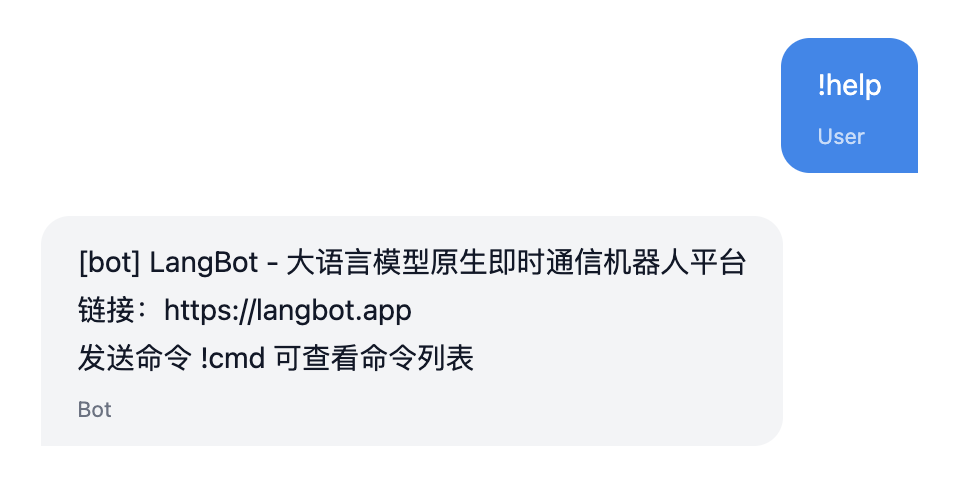
Command components are triggered by user command messages starting with ! (or other configured prefixes). Here's an example of triggering the !help command:
A single plugin can contain any number of commands. Execute the command lbp comp Command in the plugin directory and follow the prompts to enter the command configuration.
➜  HelloPlugin > lbp comp Command
Generating component Command...
Command name: info
Command description: Show information of the query
Component Command generated successfully.
组件 Command 生成成功。
This will generate info.yaml and info.py files in the components/commands/ directory. The .yaml file defines the basic information for the !info command, and the .py file is the command handler:
➜  HelloPlugin > tree
...
├── components
│   ├── __init__.py
│   ├── commands
│   │   ├── __init__.py
│   │   ├── info.py
│   │   └── info.yaml
...apiVersion: v1 # Do not modify
kind: Command # Do not modify
metadata:
name: info # Command name, users will trigger this command with !info
label: # Command display name, shown in LangBot UI, supports multilingual
en_US: Info
zh_Hans: Info
description: # Command description, shown in LangBot UI, supports multilingual. Optional.
en_US: 'Show information of the query'
zh_Hans: '发送此次消息的详细信息'
spec:
execution:
python:
path: info.py # Command handler, do not modify
attr: Info # Command handler class name, matches the class name in info.pyThe following code is generated by default (components/command/<command_name>.py). You need to register and implement subcommand processing logic in the initialize method of the Info class.
# Auto generated by LangBot Plugin SDK.
# Please refer to https://langbot.app/docs/en/plugin/dev/tutor.html for more details.
from __future__ import annotations

from typing import Any, AsyncGenerator

from langbot_plugin.api.definition.components.command.command import Command, Subcommand
from langbot_plugin.api.entities.builtin.command.context import ExecuteContext, CommandReturn

class Info(Command):

    async def initialize(self):
        await super().initialize()

        "Fill with your code here"
Adding subcommands:
...
class Info(Command):

    async def initialize(self):
        await super().initialize()

        @self.subcommand(
            name="",  # Empty string represents root command
            help="Show information of the query", # Command help information
            usage="info", # Command usage example, displayed in command help
            aliases=["i"], # Command aliases
        )
        async def send(self, context: ExecuteContext) -> AsyncGenerator[CommandReturn, None]:
            print(context)

            reply_text = f"Query ID: {context.query_id}\n"
            reply_text += f"command: {context.command}\n"
            reply_text += f"command_text: {context.command_text}\n"
            reply_text += f"params: {context.params}\n"
            reply_text += f"crt_params: {context.crt_params}\n"
            reply_text += f"privilege: {context.privilege}\n"
            reply_text += f"session: {context.session.launcher_type.value}_{context.session.launcher_id}\n"

            yield CommandReturn(
                text=reply_text,
            )

        @self.subcommand(
            name="field",
            help="Show information of the field",
            usage="info field",
            aliases=["f"],
        )
        async def field(self, context: ExecuteContext) -> AsyncGenerator[CommandReturn, None]:
            print(context)

            field_name = context.crt_params[0]
            field_value = getattr(context, field_name)

            yield CommandReturn(
                text=f"{field_name}: {field_value}",
            )
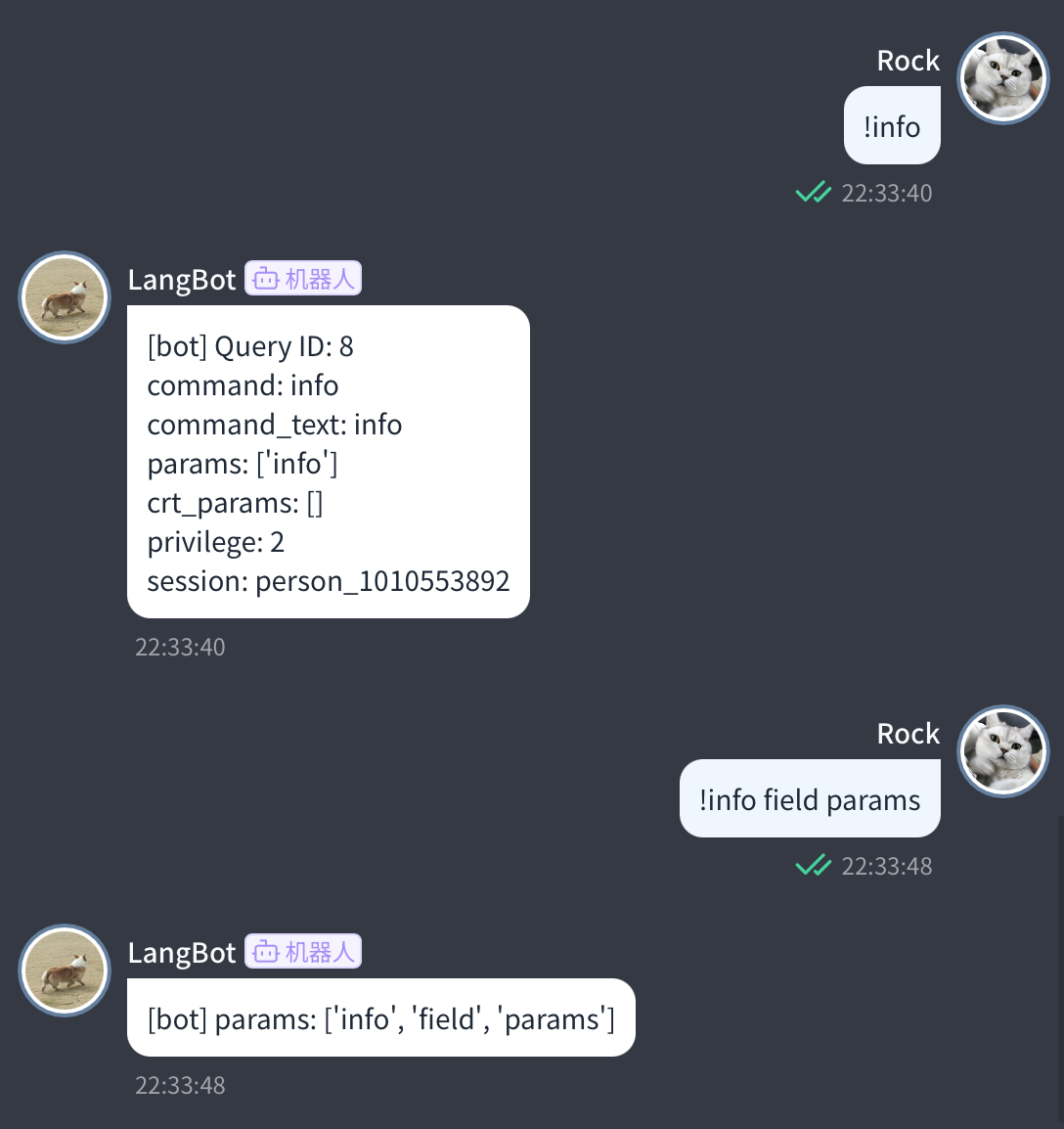
In this code, the send function is registered as a subcommand through the @self.subcommand decorator, prints the command context (ExecuteContext) information, and concatenates it into a reply message.
name is the subcommand name. Leaving it empty means handling the main command. If not empty, it matches the second parameter as the command. For example:
-
!infomatches the subcommand with name="" -
!info fieldmatches the subcommand with name="field" -
!info field valuematches the subcommand with name="field", withvalueas the subcommand parameter - Specialy,
name="*"matches all unmatched first-level subcommands, and passes each section afterinfoas parameters, for example!info 123,!info abc. You can get['123']or['abc']fromcontext.crt_params, depending on the user's input.
In subcommand functions, you can read command parameters through the context variable.
The effect of the above command is shown in the image:
class ExecuteContext(pydantic.BaseModel):
    """Single command execution context"""

    query_id: int
    """Request ID"""

    session: provider_session.Session
    """Session object for this message"""

    command_text: str
    """Complete command text"""

    command: str
    """Command name"""

    crt_command: str
    """Current command

    In multi-level commands, crt_command is the current command, command is the root command.
    Example: !plugin on Webwlkr
    When processing plugin, command is plugin, crt_command is plugin
    When processing on, command is plugin, crt_command is on
    """

    params: list[str]
    """Command parameters

    Parameter list after splitting the entire command by spaces
    """

    crt_params: list[str]
    """Current command parameters

    In multi-level commands, crt_params are current command parameters, params are root command parameters.
    Example: !plugin on Webwlkr
    When processing plugin, params is ['on', 'Webwlkr'], crt_params is ['on', 'Webwlkr']
    When processing on, params is ['on', 'Webwlkr'], crt_params is ['Webwlkr']
    """

    privilege: int
    """Session privilege level"""

    ...
Command return values (CommandReturn) currently support returning text, images (image_url, image links), and errors.
yield CommandReturn(
    text=reply_text,
)

yield CommandReturn(
    image_url=image_url,
)
Command processing supports returning multiple messages, so please use yield statements to return messages.
For specific return values, please refer to the definition of CommandReturn: langbot_plugin.api.entities.builtin.command.context.CommandReturn
You have learned the basic information about command registration and command execution. Next, you can:
- Check out Plugin Common APIs